






Introduction
One of the most frequently asked questions about TDLAS methane detection is:
"What does ppm·m actually mean?"
Unlike conventional gas detectors that report methane concentration in ppm (parts per million)at a single location, TDLAS systems output ppm·m, a measurement representing methane absorption accumulated along the laser path.
Because this measurement differs fundamentally from traditional point sensing, it is often misunderstood. This article explains what ppm·m represents, why TDLAS uses it, and how it should be interpreted during industrial methane inspections.
What Is ppm·m?
ppm·m (parts per million × meter) is the standard output unit used by open-path laser methane detection systems based on Tunable Diode Laser Absorption Spectroscopy (TDLAS).
Rather than describing methane concentration at a single point, ppm·m represents the path-integrated concentrationof methane along the entire laser propagation path.
Under ideal conditions where methane is uniformly distributed, ppm·m can be approximated as:
ppm·m = Gas Concentration (ppm) × Optical Path Length (m)
In practice, however, methane distributions are rarely uniform, so ppm·m should be understood as an integrated measurement rather than a simple multiplication.
What Does ppm·m Physically Represent?
When a laser travels through the atmosphere, it interacts with every methane molecule encountered along its path.
The measured ppm·m value therefore reflects the total optical absorption accumulated between the transmitter and the target surface, rather than the methane concentration at any single location.
In other words, ppm·m is influenced by three primary factors:
- Methane concentration
- Gas distribution along the laser path
- Effective optical path length
Because it incorporates both concentration and distance, ppm·m is better described as a spatially integrated measurementthan a local concentration value.
ppm vs. ppm·m
Although the two units appear similar, they describe fundamentally different physical quantities.
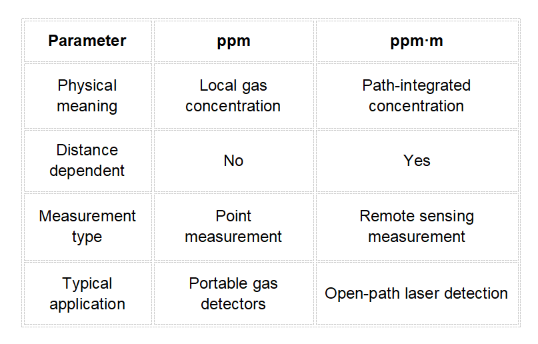
A handheld gas detector measures methane concentration only at the sensor location.
A TDLAS system measures methane accumulated along the entire laser beam.
Why Does TDLAS Use ppm·m Instead of ppm?
TDLAS determines methane concentration by measuring how much laser energy is absorbed during propagation.
According to the Beer–Lambert law, optical attenuation depends on both methane concentration and the distance through which the laser travels.
Because the laser interacts with gas continuously along its propagation path, the system cannot directly determine a single-point concentration. Instead, it reports the integrated absorption result as ppm·m.
This makes ppm·m the most appropriate engineering quantity for remote methane detection.
Engineering Value of ppm·m
For industrial methane inspections, ppm·m provides several important advantages.
- Enables non-contact methane measurement over long distances
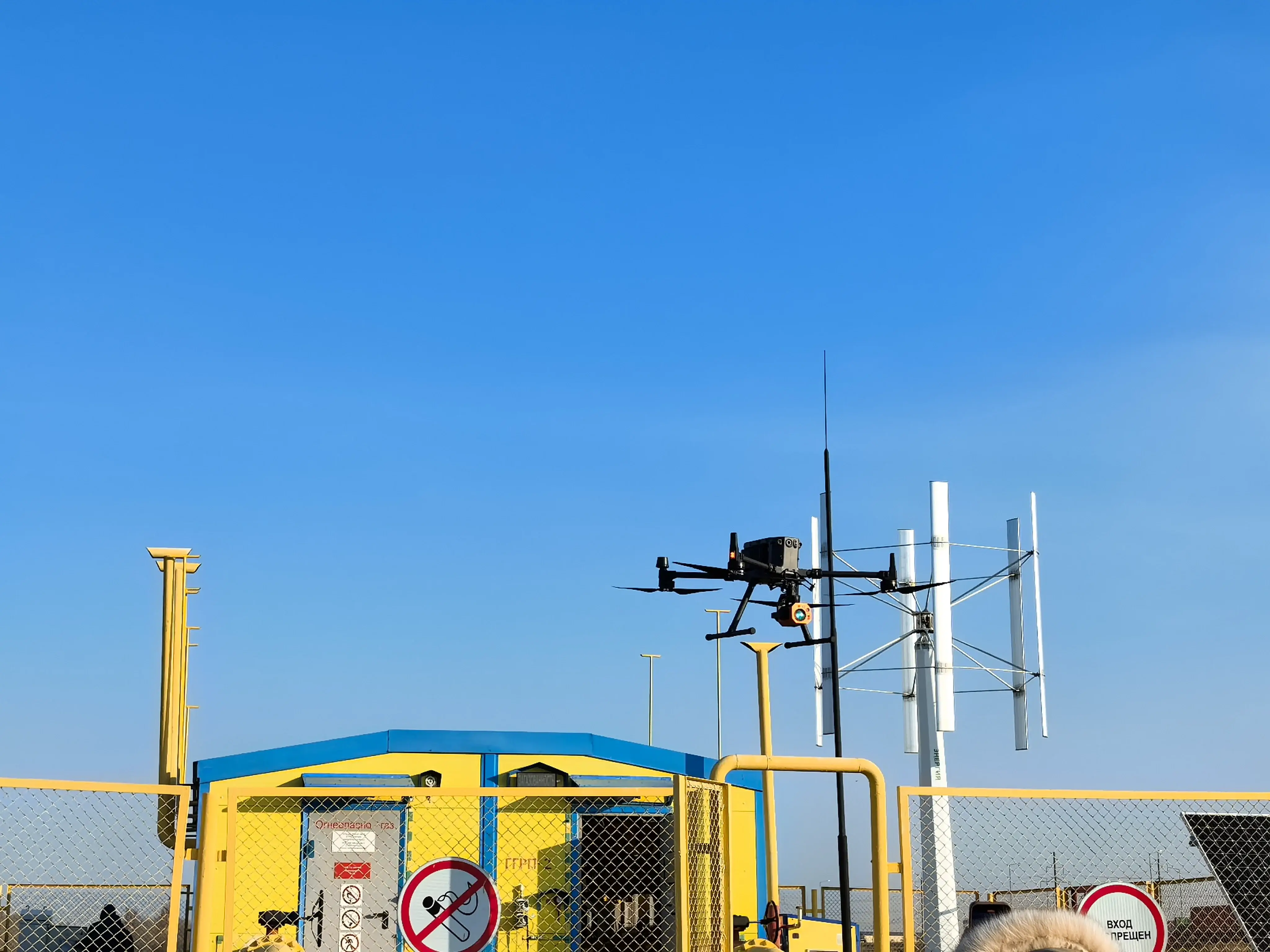
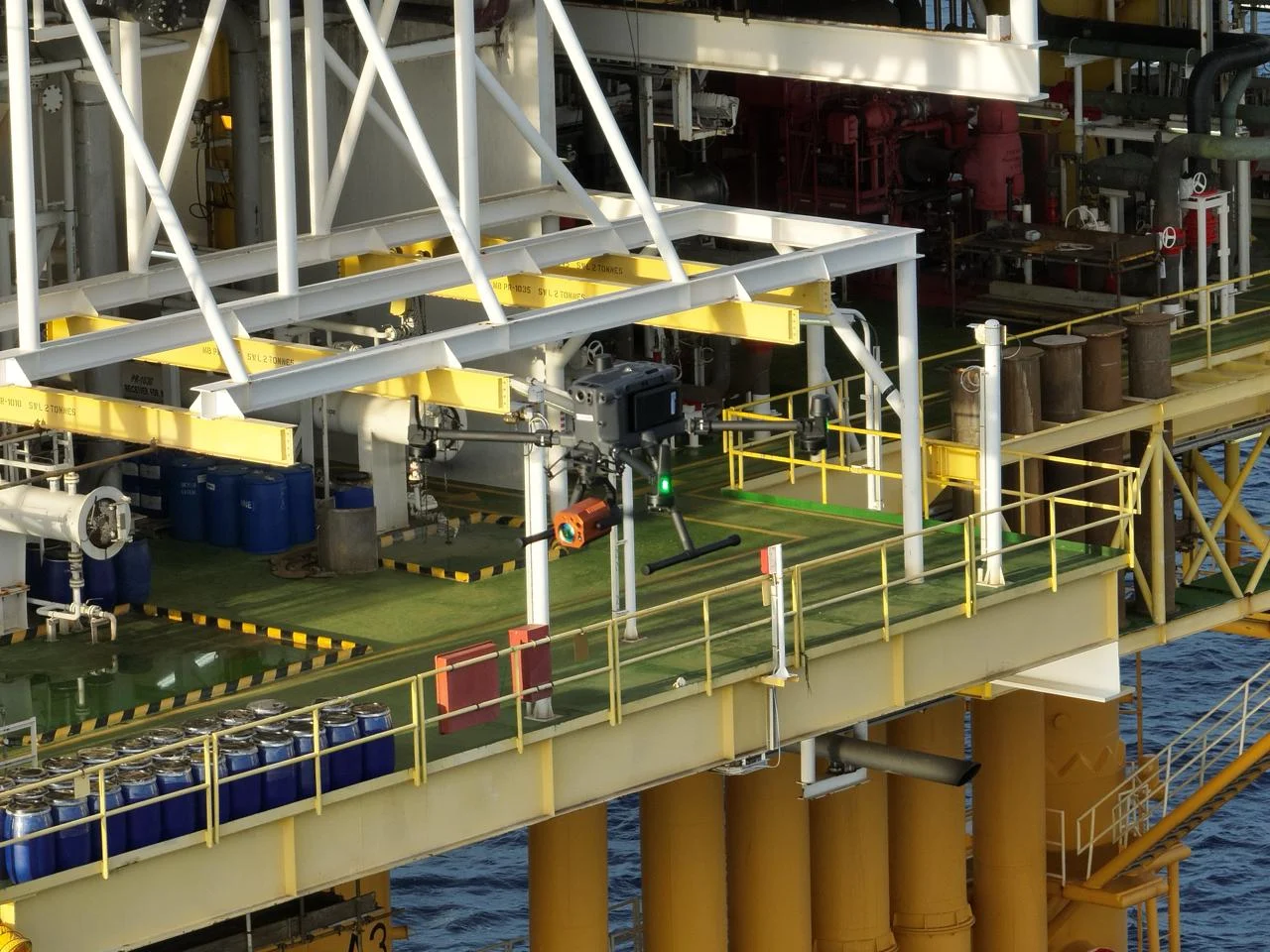
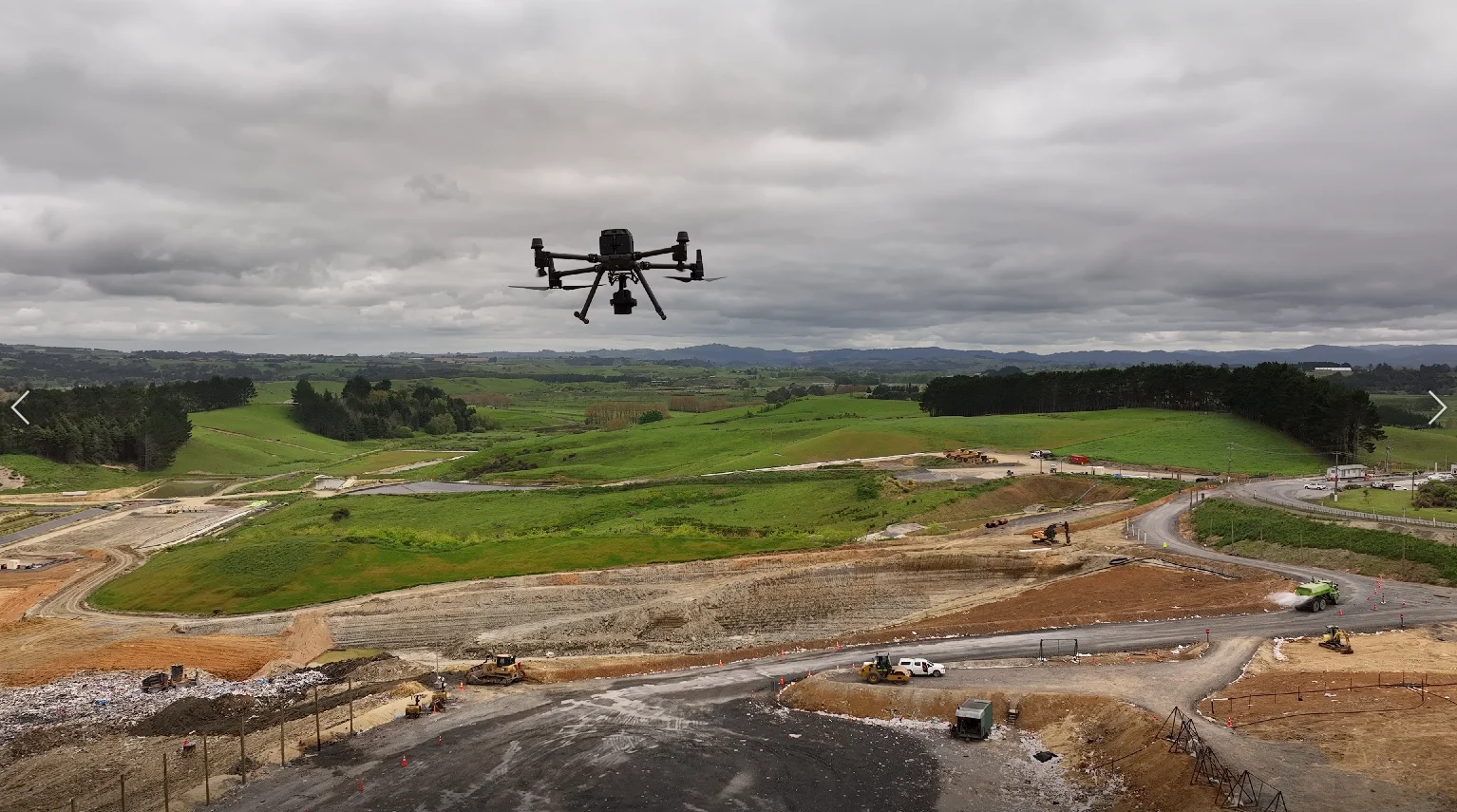
- Suitable for UAV-based inspections and open industrial environments
- Represents the overall intensity of a methane plume rather than a single sampling point
- Supports rapid screening of large facilities without requiring personnel to approach potential leak sources
- Provides consistent measurements for comparing inspection results over time
These characteristics make ppm·m particularly valuable for oil & gas facilities, pipeline inspections, landfill monitoring, and other large-scale industrial applications.
Common Misunderstandings
Several misconceptions frequently arise when interpreting ppm·m measurements.
Misconception 1: ppm·m is the methane concentration.
No.
ppm·m is a path-integrated value and should not be interpreted as the methane concentration at a single location.
Misconception 2: A higher ppm·m value always indicates a larger leak.
Not necessarily.
The measured value is influenced by methane concentration, plume geometry, optical path length, and atmospheric conditions. A longer laser path through a dispersed plume may produce a similar reading to a shorter path through a denser plume.
Misconception 3: ppm·m can be directly compared with ppm readings from handheld detectors.
No.
Because the two instruments measure different physical quantities using different principles, direct numerical comparison is generally not appropriate.
Conclusion
ppm·m is the fundamental measurement unit used by TDLAS methane detection systems.
Rather than representing methane concentration at a single point, it describes the cumulative methane absorption along the laser path, providing a stable and practical engineering metric for remote gas detection.
Understanding the physical meaning of ppm·m is essential for correctly interpreting TDLAS inspection results and making informed decisions during industrial methane monitoring.
Disclaimer
This document is intended for informational and educational purposes only. It does not constitute engineering, legal, regulatory, or operational advice. The performance and applicability of any monitoring approach may vary depending on environmental conditions, system configuration, and site-specific factors. Users should refer to applicable standards and qualified professionals for implementation decisions.
References
1. Werle, P., Mücke, R., & Slemr, F. (1993). The limits of signal averaging in atmospheric trace-gas monitoring by tunable diode-laser absorption spectroscopy.Applied Physics B.
2. Hanson, R. K. (2016). Applications of quantitative laser sensors to kinetics, propulsion and practical energy systems.Proceedings of the Combustion Institute.
3. U.S. EPA. Optical Gas Imaging and Advanced Methane Detection Technologies.
4. International Energy Agency (IEA). Global Methane Tracker.