




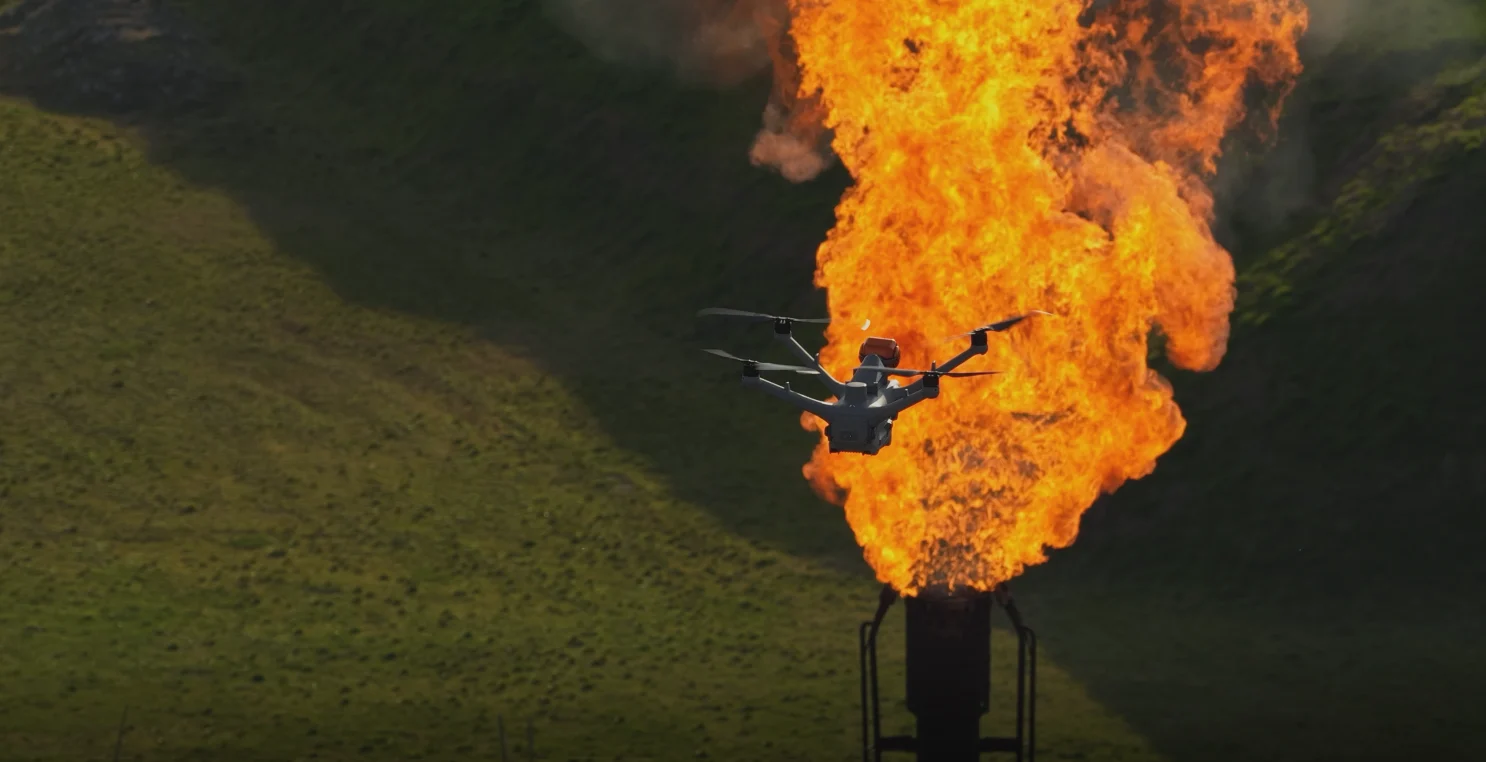

In industrial applications, users may notice that the same Optical Gas Imaging (OGI) camera can produce very different results—even when observing the same equipment or the same leak point.
At one moment, the gas plume may appear clearly on the screen. Under different conditions, it may become faint, intermittent or difficult to distinguish.
This does not necessarily indicate a change in equipment performance. OGI detection is influenced by the interaction between the gas, the surrounding environment, the optical system, the detector and the operator. Understanding these factors is essential for correctly interpreting OGI images and selecting equipment for real-world industrial applications.
1. Environmental Conditions Directly Affect Gas Visibility
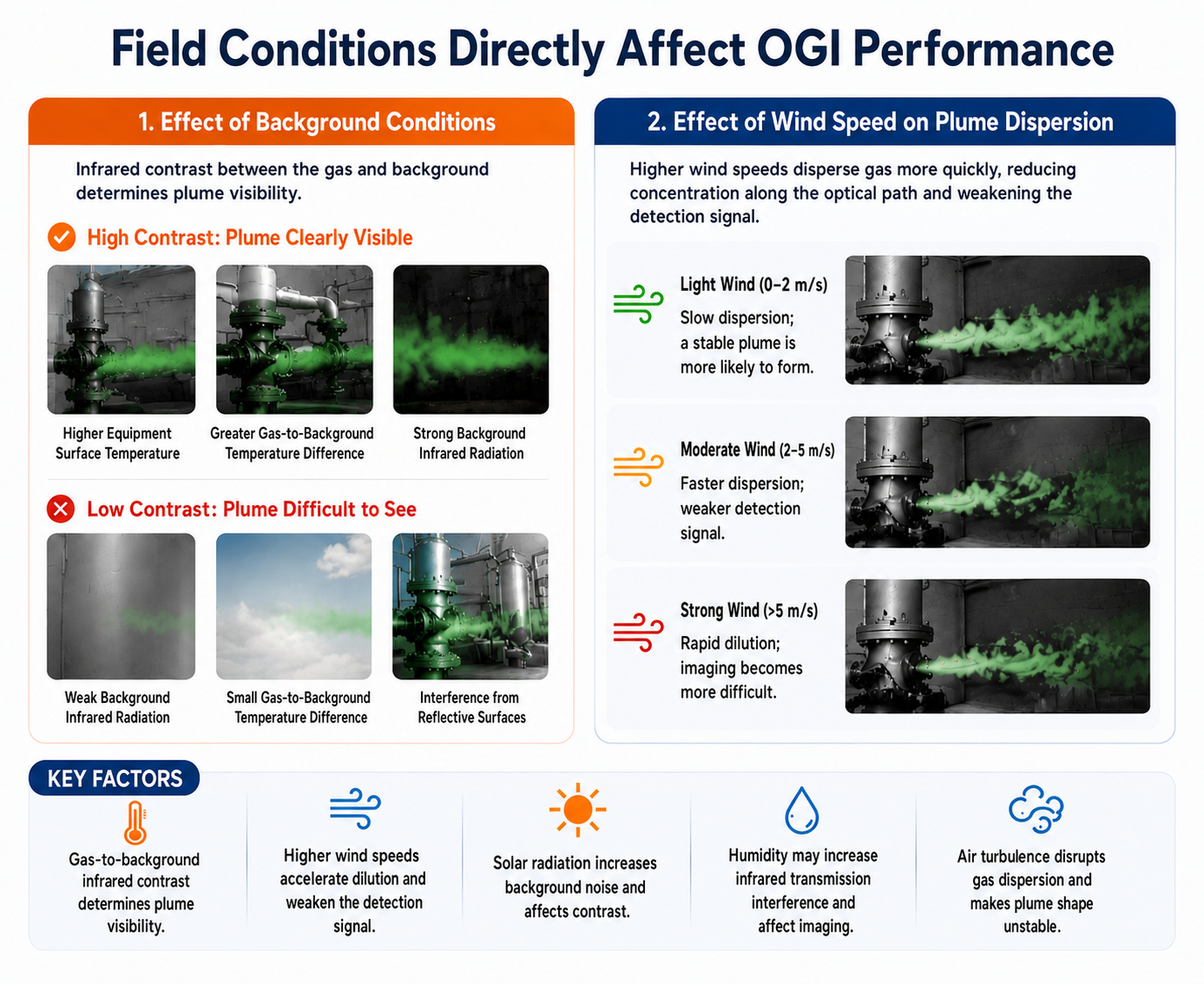
OGI cameras visualize certain gases by detecting changes in infrared radiation within a specific spectral range. For a gas plume to appear clearly, there must be sufficient apparent infrared contrast between the plume and its background.
Several environmental factors can affect this contrast.
Background temperature and material
Objects made from different materials—and objects at different temperatures—emit and reflect infrared radiation differently.
When the apparent temperature of the background is sufficiently different from that of the gas plume, the absorption produced by the gas is generally easier to distinguish. If the gas and background have similar apparent temperatures, the plume may be difficult to visualize even when a leak is present.
This is why a plume may appear clearly against warm industrial equipment but become less visible when viewed against the sky or another background with limited thermal contrast.
Wind and plume dispersion
Wind changes the shape, direction and concentration distribution of a gas plume.
Under low or moderate wind conditions, the plume may remain relatively concentrated and easier to observe. Strong or turbulent winds can disperse the gas rapidly, reducing the amount of gas along the camera’s viewing path.
Research has shown that wind conditions, release characteristics, viewing distance and background temperature contrast can all affect the probability of detecting a leak with OGI.[1][2]
Ambient temperature, humidity and solar radiation
Ambient temperature, humidity, rain, fog, solar heating and atmospheric turbulence may also influence imaging conditions.
Solar radiation can change the temperature of pipes, tanks and other background objects throughout the day. As a result, the same leak may produce different levels of infrared contrast in the morning, at midday and in the evening.
Therefore, different detection results under different field conditions are not unusual. They reflect the physical limitations and operating principles of infrared gas imaging.
2. Detection Capability Is Not Determined by Resolution Alone
Resolution is often the first specification considered when comparing OGI cameras. However, resolution mainly affects the amount of spatial detail contained in an image.
Gas detection capability depends on the combined performance of the entire imaging system.
Important factors may include:
- Detector resolution
- Pixel size
- Lens focal length
- F-number
- Noise Equivalent Temperature Difference (NETD)
- Spectral response range
- Optical filter design
- Frame rate
- Detector cooling performance
- Image-processing and gas-enhancement algorithms
Lens focal length and viewing distance
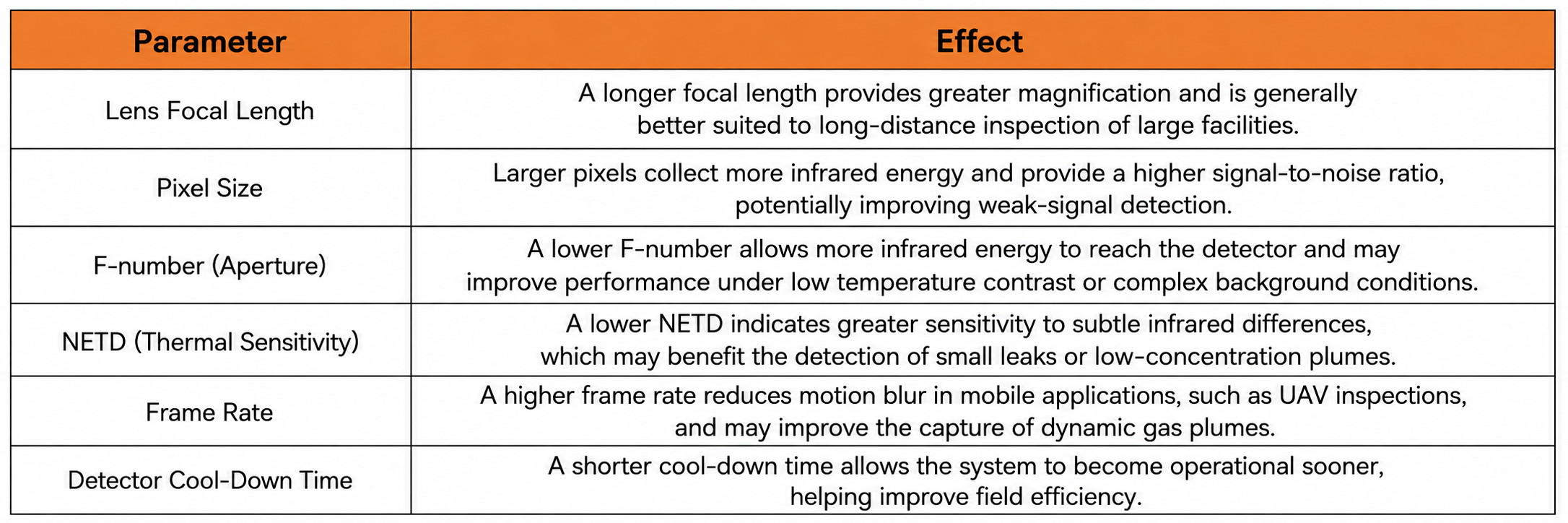
Lens focal length affects field of view and the number of pixels covering the target area.
A longer focal-length lens may provide more target detail at greater distances, but it also produces a narrower field of view. A wider lens can cover a larger area, but small or distant plumes may occupy fewer pixels in the image.
The most suitable lens therefore depends on the intended inspection distance, target size and required coverage.
NETD and detector sensitivity
NETD is commonly used to describe a thermal detector’s ability to distinguish small differences in infrared radiation. A lower NETD generally indicates greater sensitivity to subtle thermal differences under specified test conditions.
However, NETD should not be considered in isolation. Actual gas-imaging performance also depends on spectral response, optical transmission, filtering, calibration and image processing.
F-number and optical transmission
The F-number is related to the amount of infrared energy reaching the detector. A lower F-number can allow more infrared radiation to pass through the optical system, but overall performance still depends on the complete lens and detector design.
No single parameter can fully describe an OGI camera’s gas-detection capability. Equipment should be evaluated as a complete system and under conditions representative of the intended application.
3. Display Colors Do Not Directly Indicate Gas Concentration
OGI cameras may offer display palettes such as:
- White Hot
- Black Hot
- Iron
- Rainbow
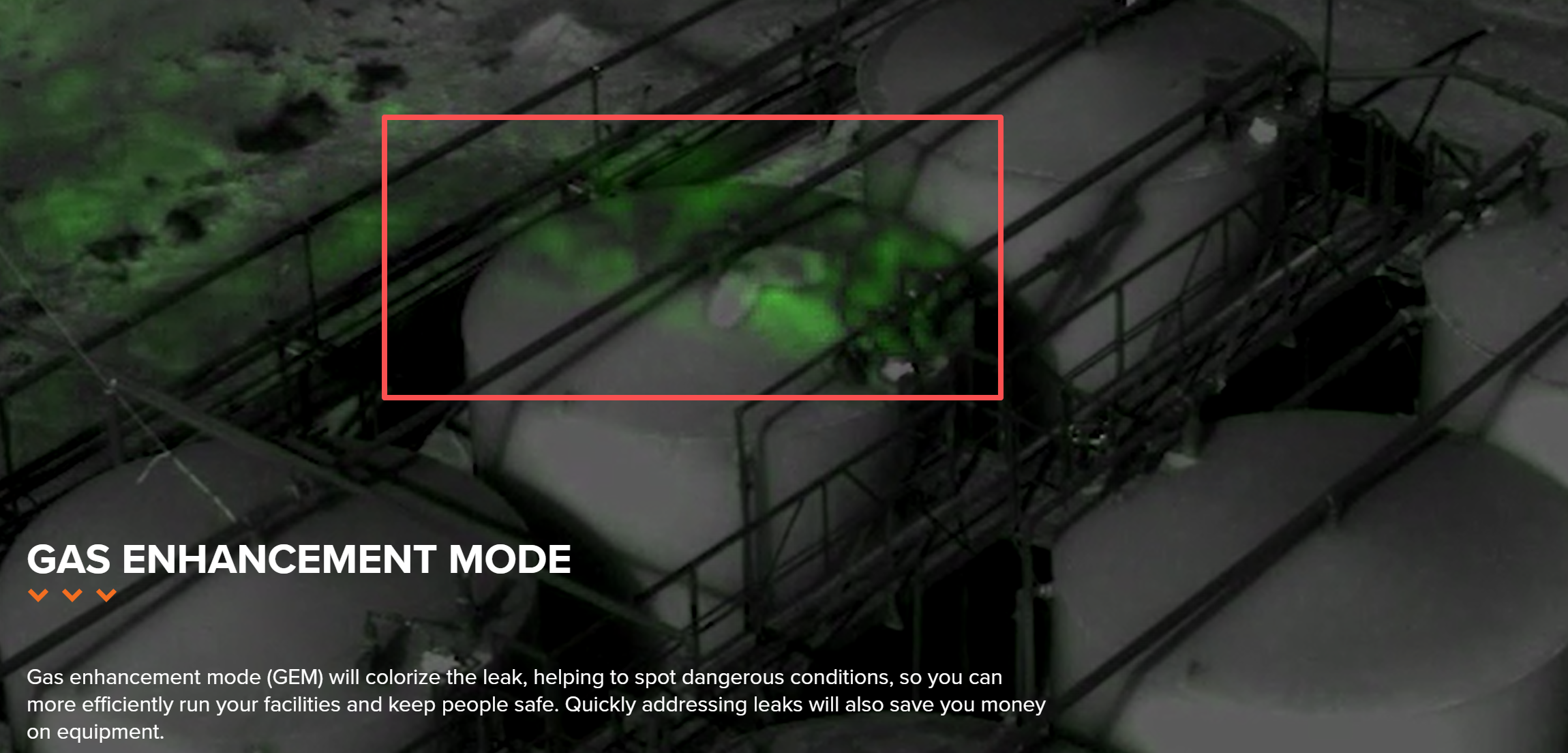
- Gas Enhancement Mode
These palettes apply different grayscale or color mappings to the infrared image. Their purpose is to improve visual contrast and help the operator identify plume movement.
The selected palette does not, by itself, indicate the type or concentration of the gas.
For example, a yellow or red area should not automatically be interpreted as representing a higher gas concentration than a gray or green area. In many display modes, the colors simply correspond to different infrared signal levels or image-processing settings.
Unless the system incorporates a validated quantitative measurement method, palette colors should not be treated as concentration measurements.
Operators should instead consider:
- Whether the plume shows continuous or repeated movement
- Whether its motion is consistent with airflow
- Whether it originates from a credible leak source
- Whether the signal remains visible when the viewing angle or background changes
These observations can help distinguish an actual gas plume from background movement, thermal reflections or image artefacts.
4. OGI Detection Does Not Automatically Mean Quantification
OGI is primarily used to visualize gas plumes and assist with leak identification and localization. It can help operators observe:
- The approximate leak location
- Plume shape and movement
- Dispersion direction
- The affected inspection area
However, conventional qualitative OGI should not automatically be interpreted as providing gas concentration, leak rate or total emission quantity.
Studies have demonstrated that OGI detection probability varies with factors such as release rate, gas composition, viewing distance, wind and background conditions.[2][3] A visible plume alone therefore does not provide enough information to determine an exact concentration or emission rate.
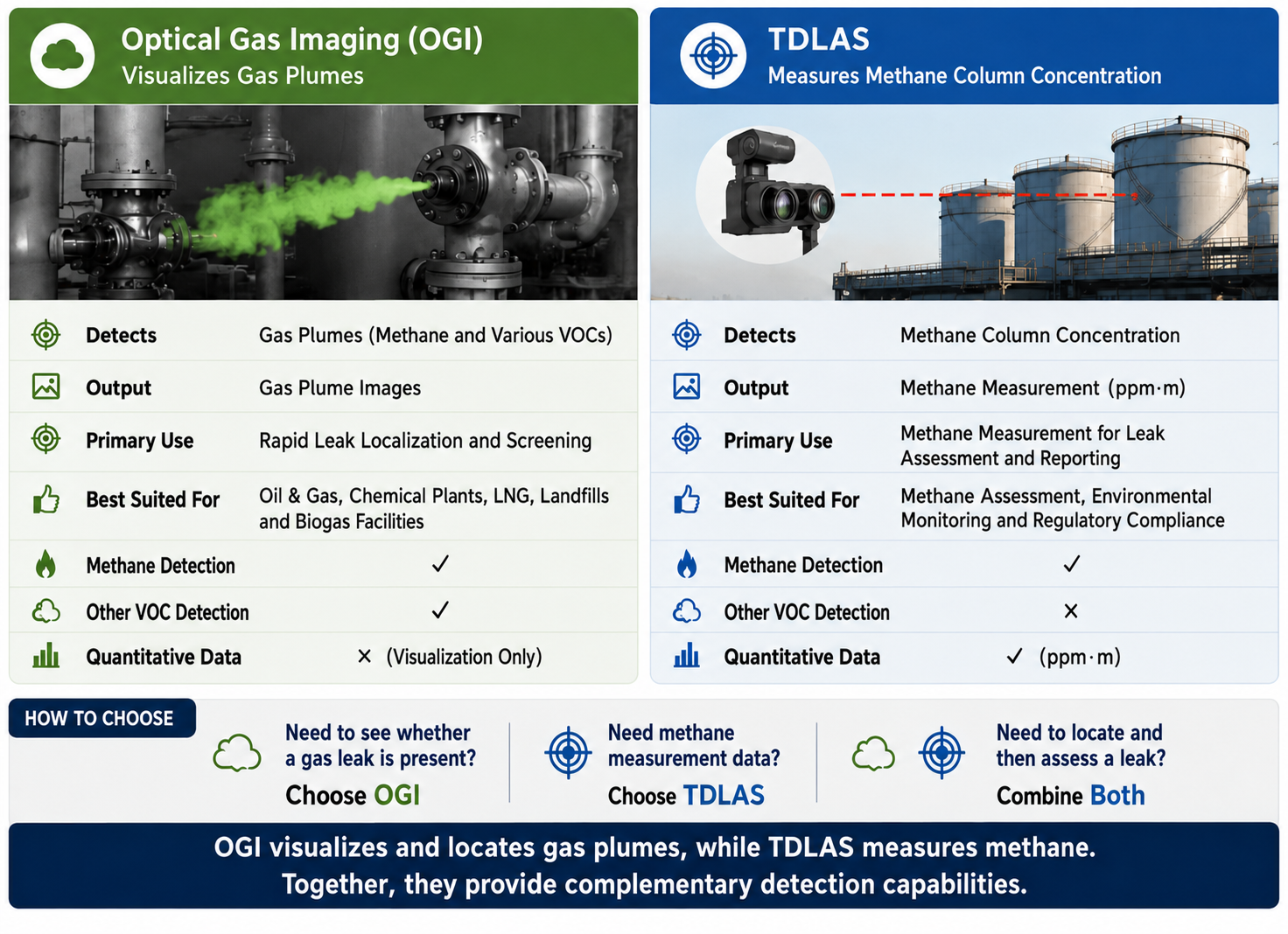
Some advanced OGI systems may provide quantitative or semi-quantitative functions. These functions require specific algorithms, calibration procedures, operating conditions and validation methods. Their results should be interpreted according to the manufacturer’s specifications and applicable regulatory requirements.
5. How Is TDLAS Different?
Tunable Diode Laser Absorption Spectroscopy (TDLAS) detects a target gas by measuring how much laser energy is absorbed at a selected wavelength.
For open-path methane detection, TDLAS instruments commonly report path-integrated concentration in parts per million-metre, or ppm·m. This value represents methane concentration integrated along the laser measurement path; it is not the same as a concentration reading at one specific point.
OGI and TDLAS therefore provide different types of information:
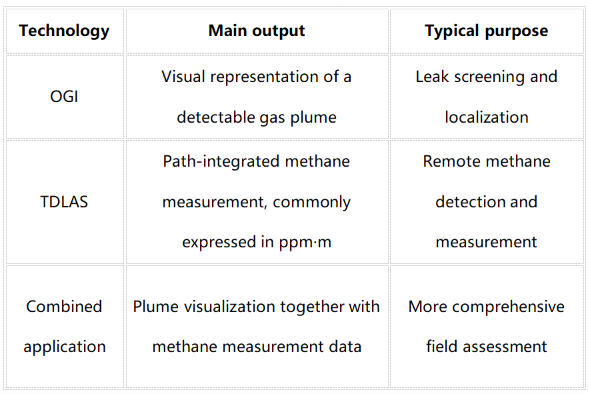
Neither technology replaces every other detection method. The appropriate approach depends on the target gas, inspection distance, required data, operating environment and applicable compliance framework.
6. Operator Technique Also Matters
OGI is not entirely automatic. The operator’s experience and inspection method can significantly affect detection results.
Important operating practices include:
- Selecting a suitable viewing angle and background
- Maintaining an appropriate distance from the target
- Adjusting focus, level and span correctly
- Observing the target for sufficient time
- Scanning slowly enough to recognize plume movement
- Understanding wind direction and site conditions
- Confirming suspected leaks from more than one viewing position
- Following applicable inspection procedures and safety requirements
The U.S. Environmental Protection Agency’s OGI protocol includes requirements related to camera performance, operating procedures, environmental conditions, inspection practices and operator training, illustrating that reliable OGI inspection depends on more than the camera alone.[4]
Understanding OGI as a Complete Detection System
OGI performance is not determined by one specification.
Environmental conditions determine whether sufficient infrared contrast can be formed. The optical system determines how effectively infrared information reaches the detector. Detector sensitivity and image-processing algorithms influence how subtle signal differences are presented. Operator technique then affects whether the plume is correctly identified and interpreted.
For oil and gas facilities, refineries, chemical plants, natural gas pipelines, offshore platforms, landfills and biogas facilities, equipment selection should therefore consider:
- Target gas and spectral compatibility
- Expected inspection distance
- Typical leak characteristics
- Field of view and lens selection
- Local weather and background conditions
- Equipment stability and environmental protection
- Operator training requirements
- Required qualitative or quantitative data
- Applicable standards and regulatory procedures
The most suitable OGI system is not necessarily the one with the highest value for a single specification. It is the system whose overall capabilities best match the intended inspection environment and operational requirements.
Technical Tip
When evaluating an OGI camera, avoid comparing resolution alone.
Lens focal length, pixel size, NETD, F-number, spectral response, frame rate, detector cooling time and image-processing capabilities can all affect real-world performance. Whenever possible, equipment should be assessed using representative gases, distances, backgrounds and environmental conditions.
Disclaimer
This article is for general information only and does not constitute technical, regulatory or operational advice. Detection performance may vary depending on equipment, environmental conditions and inspection methods. Users should follow applicable standards, regulations and manufacturer instructions.
References
1. Zeng, Y., Morris, J., Sanders, A., Mutyala, S., & Zeng, C. “Detection Limits of Optical Gas Imagers as a Function of Temperature Differential and Distance.” Journal of the Air & Waste Management Association, 2019. https://doi.org/10.1080/10962247.2018.1540366
2. Ravikumar, A. P., Wang, J., & Brandt, A. R. “Are Optical Gas Imaging Technologies Effective for Methane Leak Detection?” Environmental Science & Technology, 2017, 51(1), 718–724. https://doi.org/10.1021/acs.est.6b03906
3. Zimmerle, D. J., Vaughn, T. L., Luck, B., Lauderdale, T., Keen, K., Harrison, M., Marchese, A. J., Williams, L. L., & Allen, D. T. “Detection Limits of Optical Gas Imaging for Natural Gas Leak Detection in Realistic Controlled Conditions.” Environmental Science & Technology, 2020, 54(18), 11506–11514. https://doi.org/10.1021/acs.est.0c01285
4. U.S. Environmental Protection Agency. “Appendix K to 40 CFR Part 60—Determination of Volatile Organic Compound and Greenhouse Gas Leaks Using Optical Gas Imaging.” EPA Technical Fact Sheet
5. Hodgkinson, J., & Tatam, R. P. “Optical Gas Sensing: A Review.” Measurement Science and Technology, 2013, 24, 012004. https://doi.org/10.1088/0957-0233/24/1/012004